

Freedom of Information Request – Ref: FOI 147-2026
Thank you for your recent Freedom of Information request. Please find our response below.
You asked:
Electro Convulsive Treatment (ECT)
1. Please supply patient’s information ECT leaflet
Our response:
Please click on links below:
ECT Booklet for patients and carers
Day Patient Leaflet – headed paper – March 2021
electroconvulsive-therapy-(ect)-easy-read—dec-2022
electroconvulsive-therapy-information-resource—3-march-2022
You asked:
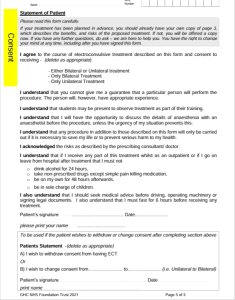
2. Please supply patient ECT consent form
Our response:
The ECT consent form is included in the ECT care pathway booklet. I have added a screenshot of the statement of patient page, which obtains the patient’s written consent
You asked:
3. Please supply any ECT reports/investigations
Our response:
We do not hold any, not applicable.
You asked:
4. How many ECT in 2025?
Our response:
584
You asked:
5. What proportion of patients were men/women?
Our response:
Male – 23%
Female – 77%
You asked:
6. How old were they?
Our response:
Old age ( 60 and above) : 36
Middle age ( 44-59) : 5
Adult ( 26-44) : 15
Young adult ( 18-25: 0
You asked:
7. What proportion of patients were classified people of the global majority or racialised communities (“POC / BAME”)?
Our response:
White- British : 94%
Asian- British : 2%
Black- British : 2%
Other: 2%
You asked:
8. How many people covered by the equality act – specific protected characteristics – excluding age + gender – received ECT ?
Our response:
Not applicable.
You asked:
9. How many people were offered talking therapy prior to ECT ?
Our response:
Patients were too unwell to be referred for talking therapy before ECT. They were offered talking therapy after completing the ECT treatment course.
You asked:
10. How many were receiving ECT for the first time?
Our response:
19
You asked:
11. How many patients consented to ECT?
Our response:
24
You asked:
12. How many ECT complaints were investigated outside the NHS ?
Our response:
Not applicable.
You asked:
13. How many patients died during or 1 month after ECT and what was the cause (whether or not ECT was considered the cause)?
Our response:
None, not applicable.
You asked:
14. How many patients died within 6 months after ECT and what was the cause (whether or not ECT was considered the cause)?
Our response:
Two.
You asked:
15. How many patients died by suicide within 6 months of receiving ECT (whether or not ECT was considered the cause)?
Our response:
None, not applicable.
You asked:
16. How many patients have suffered complications during and after ECT and what were those complications?
Our response:
None, not applicable.
You asked:
17. Have there been any formal complaints from patients/relatives about ECT?
Our response:
No.
You asked:
18. If so, what was their concerns?
Our response:
Not applicable.
You asked:
19. How many patients report memory loss/loss of cognitive function?
Our response:
One.
You asked:
20. What tests are used to assess memory loss/loss of cognitive function?
Our response:
MOCA (Montreal Cognitive Assessment)
You asked:
21. Have MRI or CT scans been used before and after ECT?
Our response:
Yes, further investigations such as MRI or CT scans were carried out before treatment to identify any contraindications for ECT and to confirm the patient’s fitness for treatment
You asked:
22. If so, what was the conclusion?
Our response:
The reports were discussed with the relevant medical teams and if the patient was fit for anaesthesia from their side proceed with the ECT
You asked:
23. How does the Trust plan to prevent ECT in the future?
Our response:
The Trust has no plans to discontinue ECT in future, as it is considered one of the most effective and life-saving treatment procedures
Restraints
You asked:
1. Please supply any Restraints/investigations
Our response:
Click on link: FOI 147-2026 – Restraint Incidents
You asked:
2. How many RESTRAINTS in 2025?
Our response:
2704.
You asked:
3. What proportion of patients were men/women?
Our response:
Male – 40.83%
Female – 50.85%
Not specified – 8.32%
You asked:
4. How old were they?
Our response:
Aged between 6 and 92 years old.
You asked:
5. What proportion of patients were classified people of the global majority or racialised communities (“POC / BAME”)?
Our response:
8.82%
You asked:
6. How many people covered by the equality act – specific protected characteristics – excluding age + gender – were restrainted?
Our response:
Not applicable.
You asked:
7. How many RESTRAINTS were investigated outside the NHS?
Our response:
Zero.
You asked:
8. How many patients died during or 1 month after RESTRAINTS and what was the cause (whether or not RESTRAINTS was considered the cause)?
Our response:
Not known as they may not be our patient at the time of death.
You asked:
9. How many patients died within 6 months after RESTRAINTS and what was the cause (whether or not RESTRAINTS was considered the cause)?
Our response:
Not known as they may not be our patient at the time of death.
You asked:
10. How many patients died by suicide within 6 months of receiving RESTRAINTS (whether or not RESTRAINTS was considered the cause)?
Our response:
Not known as they may not be our patient at the time of death.
You asked:
11. How many patients have suffered complications during and after RESTRAINTS and what were those complications?
Our response:
Zero.
You asked:
12. Have there been any formal complaints from patients/relatives about RESTRAINTS?
Our response:
One.
You asked:
13. If so, what was their concerns?
Our response:
Concern – Why were you asked to intervene and restrain your friend during self-harm attempts?
You asked:
14. Are counts of forced injections available? if so how many people were forcible injected?
Our response:
841.
You asked:
15. How does the Trust plan to reduce restraints in the future?
Our response:
Please click on link: PARRI Programme 04.06.26
You asked:
16. How many of these restraints were face down restraints?
Our response:
7.
SECLUSION
You asked:
1. Please supply any SECLUSION reports/investigations
2. How many SECLUSIONS in 2025?
3. What proportion of patients were men/women?
4. How old were they?
5. What proportion of patients were classified people of the global majority or racialised communities (“POC / BAME”)?
6. How many people covered by the equality act – specific protected characteristics – excluding age + gender – were secluded?
7. How many SECLUSIONS were investigated outside the NHS?
8. How many patients died during or 1 month after SECLUSION and what was the cause (whether or not SECLUSION was considered the cause)?
9. How many patients died within 6 months after SECLUSION and what was the cause (whether or not SECLUSION was considered the cause)?
10. How many patients died by suicide within 6 months of receiving SECLUSION (whether or not SECLUSION was considered the cause)?
11. How many patients have suffered complications during and after SECLUSION and what were those complications?
12. Have there been any formal complaints from patients/relatives about SECLUSION?
13. If so, what was their concerns?
14. How does the Trust plan to reduce SECLUSIONS in the future?
Our response:
The Trust does not use seclusion practices.
The use of De-Escalation and Extra Care Areas is different to traditional seclusion (i.e. locking a service user alone in a room) as outlined in this policy. It is important to ensure there is a consistent approach to safeguarding. The policy also supports the framework to ensure that the procedures employed are consistent with the Mental Health Act Code of Practice (2015). This was last ratified in October 2025.
Click on link for access to our policy: CLP225 De-escalation Suite DS or Extra Care Area V8 issued 30.10.25
MEDICATION ERRORS
You asked:
1. Please supply any MEDICATION ERRORS reports/investigations
Our response:
Please click on link: FOI 147-2026 – Medication Errors
You asked:
2. How many MEDICATION ERRORS in 2025?
Our response:
977
You asked:
3. What proportion of patients were men/women?
Our response:
Male – 36.23%
Female – 42.78%
Not Specified – 20.98%
You asked:
4. How old were they?
Our response:
Aged between 6 and 105 years old.
You asked:
5. What proportion of patients were classified people of the global majority or racialised communities (“POC / BAME”)?
Our response:
1.85%
You asked:
6. How many people covered by the equality act – specific protected characteristics – excluding age + gender – endured medication errors?
Our response:
Not applicable.
You asked:
7. How many MEDICATION ERRORS were investigated outside the NHS?
Our response:
Zero.
You asked:
8. How many patients died during or 1 month after MEDICATION ERRORS and what was the cause (whether or not MEDICATION ERRORS was considered the cause)?
Our response:
Not known as they may not be our patient at the time of death.
You asked:
9. How many patients died within 6 months after MEDICATION ERRORS and what was the cause (whether or not MEDICATION ERRORS was considered the cause)?
Our response:
Not known as they may not be our patient at the time of death.
You asked:
10. How many patients died by suicide within 6 months of receiving MEDICATION ERRORS (whether or not MEDICATION ERRORS was considered the cause)?
Our response:
Not known as they may not be our patient at the time of death.
You asked:
11. How many patients have suffered complications during and after MEDICATION ERRORS and what were those complications?
Our response:
Not known as they may not be our patient.
You asked:
12. Have there been any formal complaints from patients/relatives about MEDICATION ERRORS?
Our response:
Three.
You asked:
13. If so, what was their concerns?
Our response:
– Out of Hours GP prescribed incorrect medication for dry lips following use of antibiotics.
– Mother of patient very unhappy that they were prescribed a dosage of medication that was too high for the patient’s age and weight and subsequently made her ill.
– CLDT prescribed PRN medication but GP prescribed BD and both were given to patient by family due to lack of communication/medication reconciliation by clinicians.
You asked:
14. How does the Trust plan to prevent MEDICATION ERRORS in the future?
Our response:
TBC.
Next steps:
Should you have any queries in relation to our response, please do not hesitate to contact us. If you are unhappy with the response you have received in relation to your request and wish to ask us to review our response, you should write to:
Louise Moss
Head of Legal Services / Associate Director of Corporate Governance
c/o Gloucestershire Health and Care NHS Foundation Trust
Edward Jenner Court
1010 Pioneer Avenue
Gloucester Business Park
Brockworth, GL3 4AW
E-mail: louise.moss@ghc.nhs.uk
If you are not content with the outcome of any review, you may apply directly to the Information Commissioner’s Office (ICO) for further advice/guidance. Generally, the ICO will not consider your case unless you have exhausted your enquiries with the Trust which should include considering the use of the Trust’s formal complaints procedure. The ICO can be contacted at: The Information Commissioner’s Office, Wycliffe House, Water Lane, Wilmslow, Cheshire SK9 5AF.